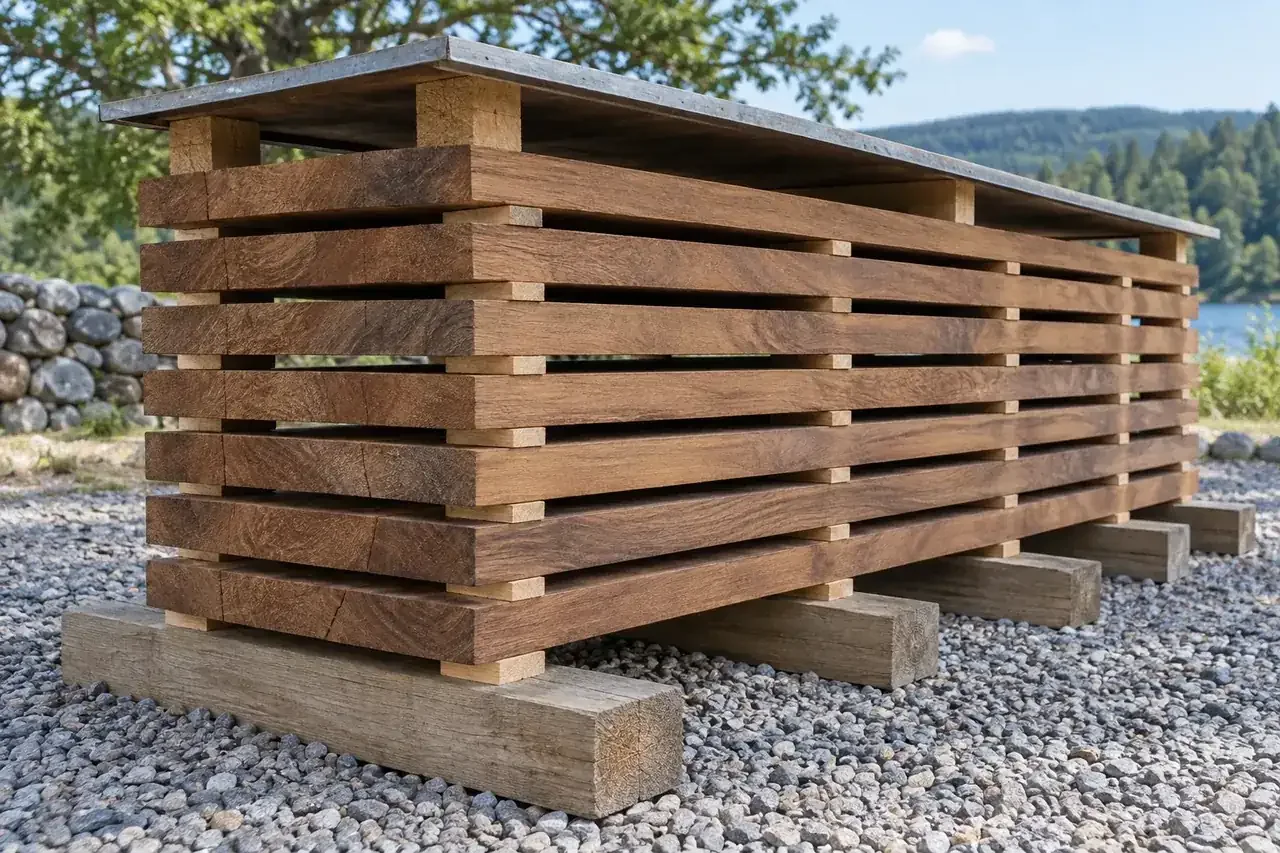
A covered stack of boards raised above a gravel surface.
Illustrative storage context. Spacer arrangement is not a prescribed schedule, and appearance cannot establish moisture content or installation readiness.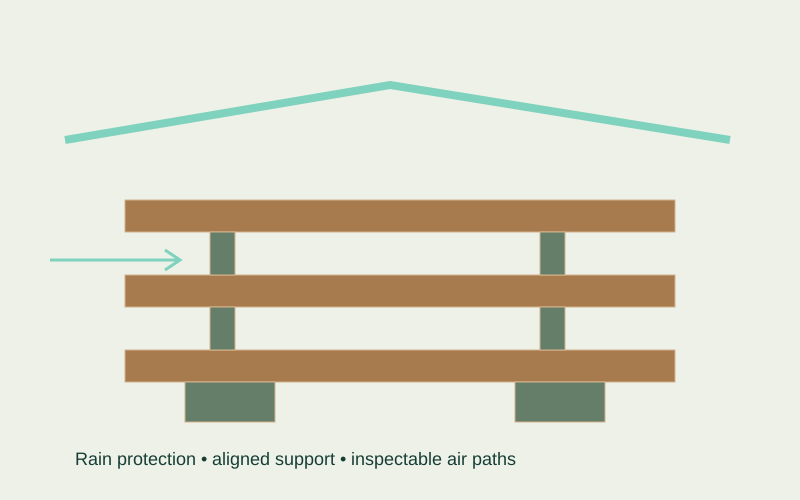
- Protect from direct wetting while preserving appropriate ventilation.
- Keep supports aligned and the stack above the ground on a stable base.
- This is a storage concept, not a universal sticker spacing or acclimation time recommendation.
Choose the location around the product instructions
Read the supplied handling and storage requirements before arranging the delivery area. Different products and conditions may call for different packaging or stacking practices. Record the chosen location and the reason it is suitable for those instructions. Avoid transferring a rule intended for one product or construction setting to all exterior lumber.
Make weather exposure visible
USDA guidance calls for protecting manufactured stock from precipitation and spray. Review where water could reach the planned location, including the exposed sides of a covered area. A roof in a photograph does not document every exposure path. Describe the actual cover and surrounding conditions, and revisit the record if weather or site activities change them. Keep direct observations separate from assumptions about hidden portions of the stack.
Plan support and access together
Use the product's requirements for support, stacking, and any spacing between courses. Arrange access so labels and selected observation positions remain identifiable without unsafe handling. Where the instructions call for stickers, follow those requirements rather than inventing universal spacing. Document areas that cannot be accessed. The suggested layout record connects physical handling with the measurement plan; it is not a structural design for storage racks.
- Retain bundle labels and your own identifiers.
- Reserve access to planned observation positions.
- Record cover, location, and layout changes.
- Keep differently affected material distinguishable.
Treat storage changes as part of the moisture history
Moving a stack, changing its cover, or opening packaging can alter the context of later observations. Date these changes and connect them to the relevant bundles. Appropriate storage conditions may help material move toward project requirements, but a layout does not establish a fixed completion time. Continue with the applicable product guidance and a documented observation method.
Choose storage for the intended exposure
An enclosed conditioned room, an open-sided shelter and an uncovered driveway are different environments. Begin with where the wood will ultimately be used and the supplier's handling requirements. Moving interior material into a damp unfinished building is not equivalent to conditioning it for its finished room. Exterior stock also needs a deliberate storage arrangement rather than an assumed waiting period outdoors.
Walk the proposed location after considering rain, runoff, ground moisture, direct sun and access. A low corner that receives roof discharge may undermine otherwise careful covering. A paved surface can still collect water. Keep the storage location identifiable on the receiving record so later changes in condition can be related to a real exposure history.
Support and spacing need to suit the material
The stack should keep boards supported and allow the inspection and air movement required by the product's handling guidance. Stickers, where specified, separate layers; their arrangement and support should be coordinated rather than scattered wherever offcuts happen to be available. Uneven support can introduce a shape problem while the team is trying to manage moisture.
Do not publish one sticker spacing, stack height or support capacity for every hardwood product. Thickness, length, packaging and site conditions differ. Obtain the relevant handling requirements and identify who is responsible for moving or restacking the material. The planner helps document the arrangement; it does not establish a safe lifting or stacking system.
| Storage feature | Useful site question |
|---|---|
| Base and supports | Can water reach the wood or collect below the stack? |
| Cover | Does it shed the expected weather without creating an unintended moisture trap? |
| Layer separation | Does the arrangement follow the product's instructions? |
| Sun and shelter | Are some faces exposed much more strongly than others? |
| Access | Can selected boards be inspected without destabilizing the stack? |
| Identification | Will lots remain distinguishable after handling? |
Do not confuse covering with sealing
A cover can protect the stack from rain while still allowing an appropriate exchange with the surrounding air. Tightly enclosing wet material may create a different condition. Conversely, removing all protection to increase airflow can expose the boards to repeated wetting. The right arrangement depends on the product, weather and storage objective; document what was actually done rather than describing any covered pack as protected.
Check the edges and ends of the cover after weather changes. Water can enter from wind-driven rain or flow from a nearby roof even when the top appears sheltered. Record evidence of wet packaging, pooled water and unequal exposure by zone. Photographs should show the overall stack as well as close views of the affected area.
Reassess when the site changes
Construction storage is rarely static. A pack may move from a warehouse to the driveway, then under a roof, then into the installation area. Note each move and whether the receiving environment is operational. Changes in heating, ventilation or enclosure matter for interior material. New shade or a cover change can also alter an exterior stack's exposure.
The USDA drying and moisture-control chapter covers moisture control during transit, storage and construction. Use the receiving guide to establish the starting condition and after-wetting guide if the protection fails. Storage records explain the conditions; the installation handoff still needs the applicable product criteria and review.
Hypothetical covered area with an exposed side
A planned storage bay has a roof but an open west side where a sprinkler reaches the edge of the stack. Before delivery, the owner chooses another position and records the revised layout. After arrival, bundle labels and selected observation faces remain accessible. The plan describes the actual protection rather than simply calling the material 'stored under cover.'
Common questions
Should every bundle be opened and stickered immediately?
Follow the instructions for the actual product and its condition. This guide does not prescribe one packaging or stacking method for all stock.
Does a good storage layout determine how many days to wait?
No. A layout supports appropriate handling and observation; it does not establish a universal acclimation period or installation decision.
Evidence & limits
Reviewed September 13, 2026. Sources support their stated technical principles; this site's workflows and hypothetical examples are not product tests, supplier approvals or independently reviewed project records.