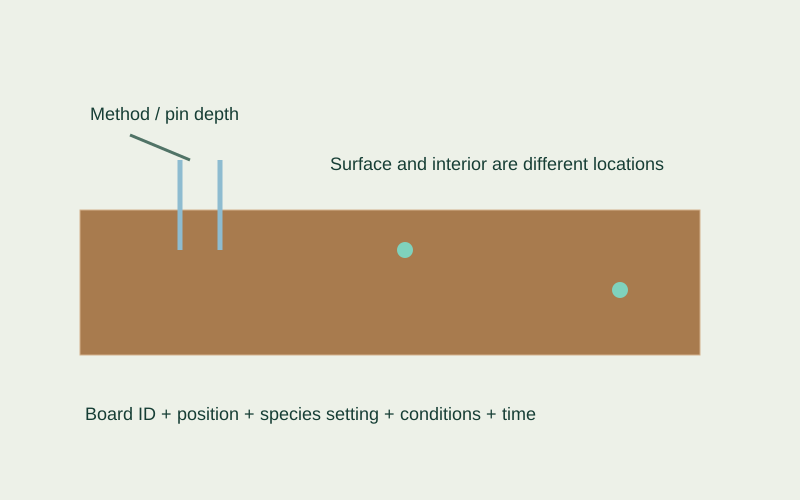
- Record the measurement method and the region it can assess.
- A surface observation does not establish the moisture condition throughout the section.
- Instrument correction and depth must follow the named meter and species documentation; dots are conceptual locations.
Record thickness before choosing the procedure
Identify the actual piece dimensions and the question being investigated. A device suitable for scanning a thinner product may not establish the condition of the center of a thicker one. Consult the model and electrode documentation before collecting numbers. This proposed planning step is particularly useful when an existing meter is being reused for a different stock size.
Describe what the sensor can observe
USDA explains that dielectric measurements can be dominated by surface layers when a large moisture gradient is present. Resistance measurements depend on their electrode arrangement; insulated electrodes can provide information at their tips. Neither principle means that selecting a deeper mode automatically measures the center of every timber. Keep the supported depth, actual placement, and physical access distinct in the record.
Design a question-specific follow-up
If the concern is a possible difference between outer and inner material, record positions or depths separately under an appropriate documented procedure. Do not blend them immediately into a single average. Mark any region the equipment cannot investigate. Where the available method is inadequate, seek an appropriate assessment rather than estimating an interior value from the exterior observation.
- Record the board dimensions and instrument model.
- Identify the electrode arrangement or sensor mode.
- Keep position and depth with every observation.
- State explicitly when the center was not assessed.
Avoid turning a depth comparison into a diagnosis
A difference between observations adds evidence about the measured regions. It does not by itself establish the cause, the total moisture distribution, or the time needed for the material to meet a requirement. Storage history and method details remain relevant. Preserve any earlier face observations so the later depth investigation has context, and attach applicable project criteria separately from the results.
Hypothetical thicker replacement component
A builder's usual meter has been used on thin boards. A much thicker replacement piece arrives, and the builder checks the manual before reusing the procedure. The initial record states that the available scan does not establish the center condition. A suitable follow-up method is arranged and its depth-specific observations remain separate. No core percentage is generated by multiplying the surface value.
Common questions
Can readings from both faces be averaged to obtain the core?
That arithmetic does not establish a core measurement. Use a procedure capable of addressing the region in question and state its limitations.
Does thicker stock always need a specified number of extra days?
This guide supplies no thickness-to-wait conversion. The actual product, condition, environment, and applicable requirements determine the assessment needed.
Evidence & limits
- USDA Wood Handbook, Chapter 13
- USDA Electric Moisture Meters for Wood
- Wagner meter manuals and species settings
Reviewed September 13, 2026. Sources support their stated technical principles; this site's workflows and hypothetical examples are not product tests, supplier approvals or independently reviewed project records.